
CALL TODAY 805-876-6756
Functional Medicine & Nutrition are being driven by increased consumer demand, advancing scientific research, and are changing the landscape of healthcare!
Functional Medicine offers a powerful leading-edge, evidenced-based, bio-individualized case approach to nutrition care that significantly improves your client’s health outcome. Functional Medicine combines modern science, individualized functional assessments and specialty laboratory testing, critical thinking, root-resolution, and prevention of chronic disease to replace the outdated and ineffective acute-care one-size fits all model. Functional Medicine is a forward thinking, holistic, whole body approach that actually helps the client find true health and balance that is sustainable.
Functional Medicine utilizes the latest in genetic science, systems connections, and understanding of how environmental and lifestyle factors influence the development and progression of disease
Functional Medicine enables physicians and other health professionals to practice proactive, predictive, personalized medicine and empowers patients to take an active role in their own health.
Functional Medicine addresses the underlying causes of disease, using a systems-oriented approach and engaging both patient and practitioner in a therapeutic partnership. It is an evolution in the practice of medicine that better addresses the healthcare needs of the 21st century. By shifting the traditional disease-centered focus of medical practice to a more patient-centered-whole body approach, Functional Medicine addresses the whole person, not just an isolated set of symptoms. functional health practitioners spend time with their patients, listening to their histories and looking at the interactions among genetic, environmental, and lifestyle factors that can influence long-term health and complex, chronic disease. In this way, Functional Medicine supports the unique expression of health and vitality for each individual.
1. An understanding of the biochemical individuality of each human being, based on the concepts of genetic and environmental uniqueness;
2. Awareness of the evidence that supports a patient-centered rather than a disease-centered approach to treatment;
3. Search for a dynamic balance among the internal and external body, mind, and spirit;
4. Interconnections of internal physiological factors;
5. Identification of health as a positive vitality, not merely the absence of disease, and emphasizing those factors that encourage the enhancement of a vigorous physiology;
6. Promotion of organ reserve as the means to enhance the health span, not just the life span, of each patient.
A patient-centered approach refers to health care that is respectful of and responsive to individual patient preferences, needs, and values, and that ensures that patient values guide all clinical decisions. At FNA, patient-centered care is the core of what we call the therapeutic partnership; the relationship that forms between a patient and clinician that empowers the patient to take ownership of their own healing. The power of the therapeutic partnership comes from the idea that patients who are active participants in the development of their therapeutic plan feel more in control of their own well-being and are more likely to make sustained lifestyle changes to improve their health.
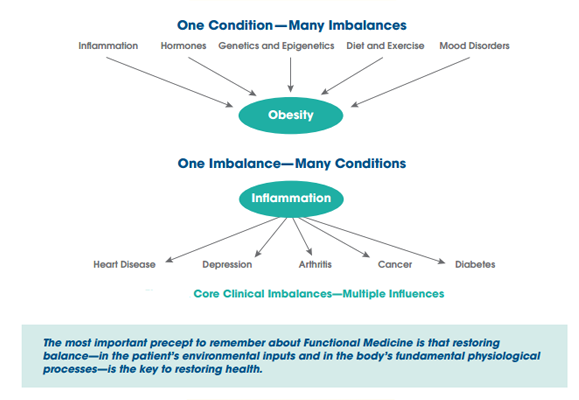
Conventional medicine separates doctors based on their specialties (e.g., neurology, gynecology, endocrinology), effectively arranging medical care into separate silos. Functional Nutrition is holistic, in that one clinician looks at all aspects of the patient, instead of saying, “Oh, that sounds like a hormone problem. That’s not my department.”
Functional Medicine is highly cost effective for patients, as it focuses on prevention and health promoting lifestyle changes and sustainable treatments that address the underlying causes of dysfunction, restoring patients to health. Conventional medical treatments often involve expensive medications that must be taken indefinitely and do not address the underlying problem, but merely suppress the symptoms.
Functional Medicine is health-oriented holistic medicine that takes account of the whole person (body, mind, and spirit), including all aspects of lifestyle. It emphasizes the therapeutic relationship and makes use of all appropriate therapies, both conventional and alternative.
If you’re already studying and practicing integrative medicine, then you know something about whole-person modalities. Functional Medicine provides an architecture that will help you organize and apply all that knowledge in a systematic way, digging deeper into the origins of disease and the determinants of health.
The Functional Medicine model considers the diagnosis, of course, but also seeks to answer the question, “Why does this person have this illness?” The answer to this question is revealed by discovering the antecedents, triggers, and mediators that underlie symptoms, signs, illness behaviors, and demonstrable pathology. Further, medical genomics can identify the phenotypic expression of disease-related genes and their products, affording another lens through which to view illness. Chronic diseases cut across multiple organ systems, and this calls for a systematic method of viewing each patient.
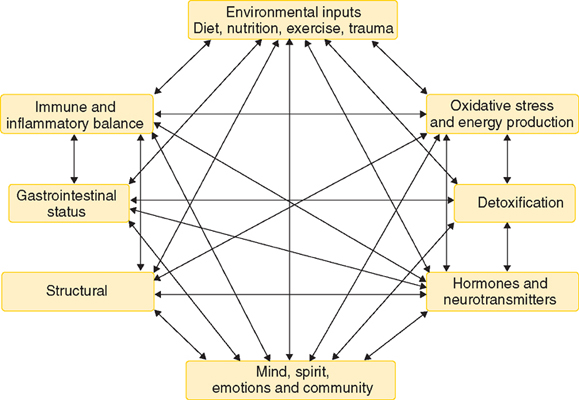
Practitioners of Functional Medicine use the Functional Medicine model to organize their findings. It’s a kind of flexible and adaptive information-gathering-and-sorting architecture for clinical practice that deepens the clinician’s understanding of the often overlapping ways things can go wrong. The patient’s story is organized according to eight underlying, connected mechanisms that influence health, which clarifies the level of present understanding and illuminates where further investigation is needed. An operating system guides clinicians through the entire process from gathering information to initiating treatment and tracking the patient’s progress.
Functional Medicine offers a new approach to management and prevention of chronic disease that embodies the art and science of medicine. It integrates what we know about how the human body works with patient-centered, science-based care. Functional Medicine addresses the causes of chronic disease, which are rooted in lifestyle choices, environmental exposures, and genetic influences. It also emphasizes the therapeutic partnership, which engages the heart, mind, and spirit of both practitioner and client, and encourages moments of deep insight that contribute to more comprehensive answers to stubborn, complex medical problems. Functional Nutrition offers a paradigm shift in clinical practice, thus producing a more effective response to chronic disease.
Functional Medicine is a different approach, with methodology and tools that are specifically designed to prevent and treat chronic diseases.